
Author: Gary Backlund, Senior Chiropractor, M.Tech Chiro (RSA), a member of the General Chiropractic Council.
The most useful thing a patient told me recently was not about his shoulder at all. It was that he had reconstructed his knee ten years ago and had not thought about it since.
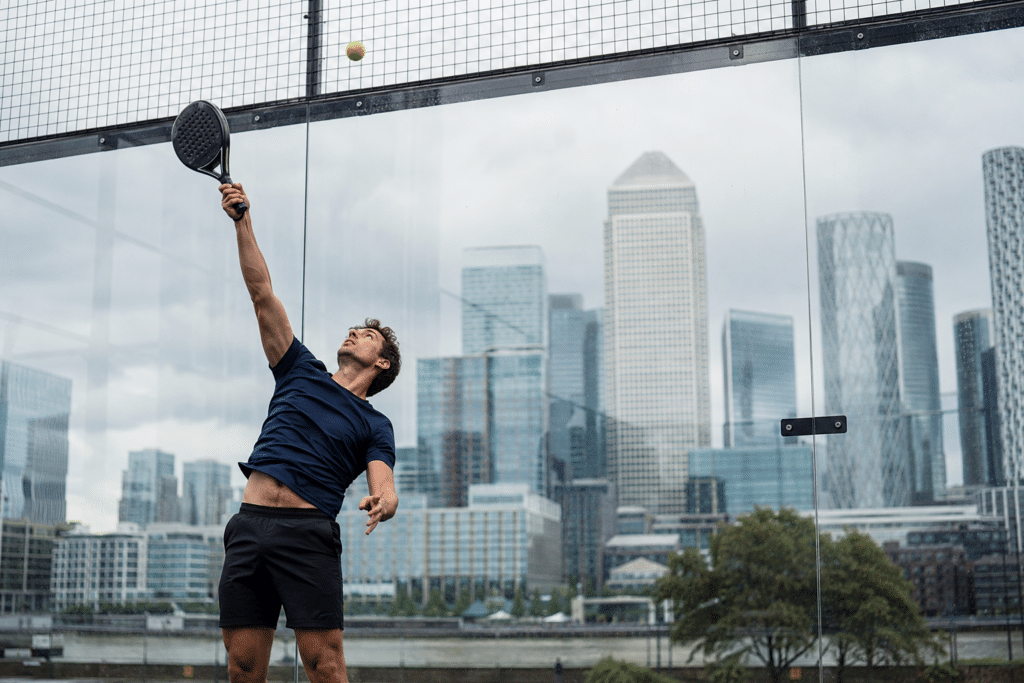
He is a padel player. He had come in with four months of shoulder pain that arrived on court and returned every time he went back, despite rest, a physiotherapist and a set of exercises he had actually done.
When a shoulder quietens down with rest and flares again on the first match back, the painful tissue is rarely the whole story. It is one layer. The mechanics immediately around the shoulder are a second. And occasionally there is a third layer nowhere near the shoulder, in how the whole body carries and distributes load, quietly changing the position the arm has to start from.
This is a worked example of the three layers of treatment, using a case I am still in the middle of.
Layer 1: the painful shoulder
The examination was consistent with rotator cuff related shoulder pain, with findings that pointed towards the supraspinatus. Worth saying that examination narrows things down rather than naming one tendon with certainty.
The rotator cuff is a group of muscles and tendons that control and stabilise the shoulder joint. They matter most when the arm goes up and over, which in padel means the smash, the bandeja and the high ball coming off the back glass. The serve is not one of them, because a padel serve is played underarm at or below waist height. It is the overhead shots that load the cuff, and a long match is full of them.
That was Layer 1: the tissue that was actually sore.
The useful pattern was that his symptoms tracked his exposure to padel. They were quieter during the weeks he stayed off court, and they returned when he went back. So the question stopped being what hurts, and became why his rotator cuff keeps being overloaded in the first place.
Layer 2: what is happening around the shoulder
Once I looked past the painful tendon, the rest of his upper body started to explain itself.
His head sat noticeably forward. The muscles across the front of his chest and shoulders were very tight. The whole shoulder girdle had effectively travelled forwards and settled there.
That matters, because a shoulder does not work on its own. For the arm to travel overhead efficiently, the shoulder blade, the upper back, the joint itself and the muscles around all of it have to move together.
If the shoulder is sitting further forward than it should, and the upper back is not moving well, the mechanics of lifting the arm change. The cuff ends up doing its job from a starting position that makes the job harder.
So there was Layer 2. The irritated cuff was Layer 1, but the position and posture around the shoulder may have been contributing to why it kept getting irritated. The assessment also turned up something further away.
Layer 3: the finding that was not in his shoulder at all
When I looked at how he was loading through the whole body, there was a significant tilt through the pelvis.
At which point his history became relevant in a way it had not seemed to be.
Around ten years ago, he had an ACL reconstruction of his knee.
The knee injury itself was a decade behind him and gave him no trouble. But he described a long-standing habit of loading and protecting that side, and there was a side-to-side difference in the movements we assessed. Whether that began with the knee or developed later is genuinely difficult to say, and a tilt seen standing still does not on its own prove how someone loads in motion.
The body is very good at compensating. If the pelvis is not level, the rest of you does not simply stay tilted. The spine, the ribcage, the shoulders and the head all make adjustments to keep you upright and your eyes level.
In his case, one of those adjustments appeared to be a noticeably lower right shoulder, on the same side as the pain.
That is an association worth noting rather than proof of a cause, and this is the point where a story like this can run ahead of itself. Asymmetry of this kind is common, including in plenty of people who have no pain at all, and the route from pelvis to shoulder is not a predictable cascade. What it gave us was a hypothesis to test alongside the shoulder-specific findings, not an explanation to settle on.
Now think about the smash
Imagine starting every overhead shot with one shoulder already sitting lower than the other.
Every time he lifts the racket, the shoulder is working from an altered starting position.
Do that once and it is unlikely to matter at all. Do it several hundred times across a week of padel and the arithmetic changes.
The rotator cuff may well be the tissue that becomes painful. But repeatedly treating only the rotator cuff does not necessarily change the mechanics putting load through it.
Which is potentially why the breaks read so well and lasted so badly. Take away padel and you take away the repeated overhead load, so the symptoms quieten. Go back to the same movement with the same mechanics underneath it, and they return with it.
Does that mean the shoulder exercises were wrong?
Not at all.
Rotator cuff rehabilitation and appropriate strengthening are an important part of recovering from most shoulder problems, and rehab and strengthening work is a large part of what we do here.
But strengthening a shoulder and changing the mechanics that shoulder is working within are two different jobs.
If someone responds well to conventional shoulder rehabilitation and gets back to their sport without further trouble, that is the end of the story and no third layer is needed. If the pain keeps returning despite sensible rest, rehabilitation and strengthening, it becomes worth asking what else might be going on.
That is when looking beyond the painful area earns its place.
What we are actually aiming at
For this patient, a comfortable shoulder while he sits at home was never the goal.
He wants to play padel.
So the plan works through the layers in order: settle the irritated tissue, improve the mechanics immediately around the shoulder, and address the wider findings that may be loading it. Then progressively load the shoulder again and test the only thing that actually matters, which is whether he can play a full match without it flaring afterwards.
That is where we are with him now. It is not a finished story, and one person’s assessment is not evidence of what would happen for anybody else with shoulder pain. It is an illustration of why we assess the way we do.
Related reading
The model itself: the three layers of treatment. The other worked examples: outside knee pain in runners and cyclists and plantar fasciitis that will not go away.
FAQ
What is the rotator cuff?
It is a group of four muscles and their tendons that sit around the shoulder joint and help control and stabilise it, particularly when the arm is lifted away from the body or overhead. Supraspinatus contributes to lifting the arm, though symptoms and examination do not always identify one cuff tendon as the sole source.
Is padel especially hard on shoulders?
We see a fair amount of it, though there are padel courts very close to the clinic, which is probably the honest explanation for that rather than anything about the sport itself. What padel does do is ask for a lot of repeated overhead movement in a short space of time, and repetition is what tends to expose a mechanical problem that was managing quietly until then.
Should I stop playing while it settles?
Most people ask this hoping the answer is no, and it is rarely a straight yes. Stopping does settle the shoulder, which is exactly what this patient found, and it tells you very little about what will happen when you start again. So a break is worth a good deal as information and not much as a plan. What tends to be more useful early on is cutting out the overhead shots specifically rather than the sport entirely, then building back from there.
Why did the rehabilitation work and then stop working?
That pattern is common and it is informative rather than discouraging. If something settles with rest and reliably returns with the activity, it suggests the activity is still loading the tissue the same way it did before. That is a reason to look at the mechanics around the movement, not a sign the rehabilitation was pointless.
Could an old knee injury really affect my shoulder?
Not usually, and it is not something we go looking for by default. In this particular case there was a clear pelvic asymmetry, a long history of loading one side differently, and a shoulder sitting lower on the same side that hurt. That combination made the history worth taking seriously. On its own, an old knee operation explains nothing.
If your shoulder is fine until you play and sore every time afterwards, the thing worth establishing is what it is starting each swing from. Book an appointment at MyChiro Clinic in Canary Wharf.
This article describes one patient’s assessment and is general information, not individual clinical advice and not a diagnosis. Every shoulder is assessed on its own. If you have new, severe or worsening symptoms, weakness or numbness in the arm, a shoulder that will not move at all, or pain following a fall or a dislocation, please speak to your GP.