
Author: Gary Backlund, Senior Chiropractor, M.Tech Chiro (RSA), a member of the General Chiropractic Council.
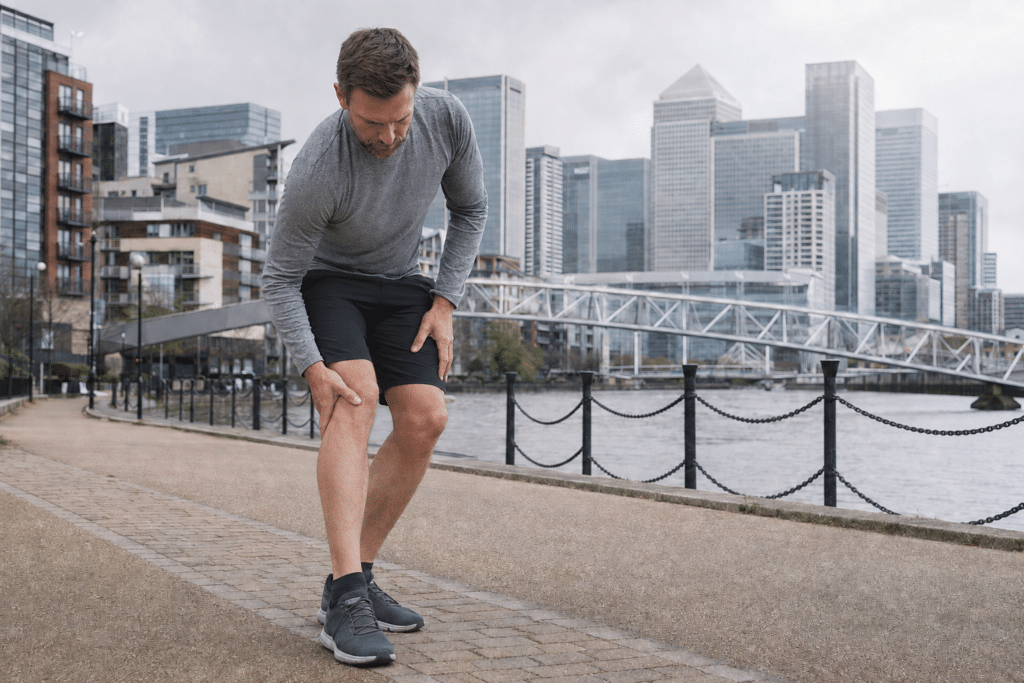
Pain on the outside of the knee in runners and cyclists is often associated with the iliotibial band, the thick band of tissue running down the outside of the thigh. The knee is where it hurts. It is not always where the problem starts, and running is often the load that finally exposes it rather than the thing that created it.
I am going to start writing about the problems we see most often using the layers as a way in, because the same question comes up every time: why did this happen to me, and why now?
Here is the first example.
The pain might turn up after a certain distance when running, during longer rides, or when the knee is bent and straightened repeatedly. Worth saying early: where the pain is felt does not by itself confirm what is causing it. That is what an assessment is for, and the rest of this article assumes one has happened.
So how would we look at this using the three layers?
Layer 1: what is actually hurting?
The first layer is the painful area itself.
With ITB-related knee pain, repeatedly bending and straightening the knee can irritate or compress the tissues around the outside of the knee. That is where the pain is felt.
Early treatment is aimed at calming the irritated area and reducing whatever keeps aggravating it. Depending on the person, that might include:
- temporarily reducing running, cycling or whatever else is provoking it
- ice for short-term symptom relief
- pain relief or anti-inflammatory medication where that is suitable for you, on the advice of your GP or pharmacist
- treatment of tight or sensitive muscles and soft tissues around the hip and thigh
- gradually reintroducing activity as symptoms allow
That is Layer 1. We are dealing mainly with the painful tissue and helping the current episode settle. It is also, in most cases, the part that private medical insurance is designed to cover.
But there is a second question worth asking.
Why did that particular knee become irritated in the first place?
Layer 2: what is happening around the knee?
Now we start looking at the mechanics closest to the problem.
For a runner, that includes the way the foot and ankle move and load, particularly at the moment the foot hits the ground. We might look at ankle mobility, how much the foot rolls in or out, running mechanics and footwear.
For a cyclist, we would also look at foot position, cleat position, saddle height, and how the knee tracks through the pedal stroke.
If something lower down the chain is repeatedly altering the way the knee travels, the tissues on the outside of the knee may be exposed to more load than they are happy with.
Layer 2 work might therefore involve improving joint mobility, working on the surrounding muscles and soft tissues, strengthening where appropriate, and addressing footwear or the mechanics of the activity itself.
Layer 3: why is one area taking more of the load?
Layer 3 pulls back again.
Instead of concentrating on the knee, the foot or the ankle, we look at how the whole body is managing and distributing load. The position and movement of the pelvis can be particularly relevant here.
People who spend a lot of the day sitting, for example, can develop changes in hip mobility, muscle function and pelvic position. An increased forward tilt of the pelvis may come with increased tension through the muscles at the front and side of the hip, including the tensor fasciae latae, which connects into the iliotibial band itself.
So changes around the pelvis and hip can influence tension and loading a long way further down the leg.
We would also look at whether the pelvis is moving symmetrically, and at how effectively the spine, pelvis and hips are absorbing and distributing the forces generated while running.
So did running actually cause the problem?
Not necessarily.
The runner might reasonably say: “my knee started hurting because I started running.”
Running may only be the activity that finally exposed it.
The painful knee is Layer 1. The mechanics of the leg, ankle and foot are Layer 2. Longer-standing mechanics through the pelvis, hips and spine may be Layer 3.
Some of those changes may have been developing for months or years without causing any symptoms at all. Increasing distance, frequency or intensity may simply have added enough load for the knee to become painful.
Which is the whole point of the layers. Treating the painful knee and understanding why that knee became overloaded are two very different pieces of work, and you are entitled to choose either one.
Training for something and worried about the knee? Book an assessment at our Canary Wharf clinic.
Where this fits in the series
This is the first of what will be a run of worked examples using the same three layers. If you have not read them yet, start with the three layers of treatment, then why your back goes over something as small as putting your shoes on.
FAQ
What is the iliotibial band?
It is a thick band of connective tissue that runs down the outside of the thigh, from the hip to just below the knee. It connects at the top with muscles including the tensor fasciae latae, which is one reason hip and pelvis mechanics can be relevant to pain felt at the knee.
Should I stop running completely?
Not necessarily, and that is worth assessing rather than guessing. Early on, reducing what is repeatedly provoking the pain is usually part of the plan, but complete rest is not automatically the answer and the aim is to get you back to your training.
Why does it only hurt after a certain distance?
A pattern like that is common with load-related problems. The tissue copes for a while and then reaches the point where it stops coping, which is why the same run can be comfortable for two miles and not for five.
Could my bike setup be the problem?
It can be part of it. Cleat position, saddle height and how the knee tracks through the pedal stroke all affect how the knee is loaded, repeated thousands of times a ride. We would look at that alongside how your hips and pelvis are moving rather than in isolation.
Do I need a scan?
Most of the time, no. If anything in the assessment suggests it is needed, or if the problem is not behaving as expected, we will say so and arrange onward referral or discuss it with your GP.
If knee pain is interrupting your training, an assessment can work out which layer it is coming from. Book an appointment at MyChiro Clinic in Canary Wharf.
This article is general information about a common presentation. It is not individual clinical advice and it is not a diagnosis. If you have new, severe or worsening symptoms, or the knee gives way, locks or swells, please speak to your GP.