
Author: Gary Backlund, Senior Chiropractor, M.Tech Chiro (RSA), a member of the General Chiropractic Council.
It is a very reasonable question, and it usually comes at the end.
You have spent several months working on your posture, your mobility and the way your body moves. You have been through all three layers: getting out of pain, improving the local mechanics, and working on the bigger picture. Your posture looks better. You are moving better. Perhaps your weight is more evenly distributed and your measurements have changed.
So are you done? Will it simply stay like that?
Not automatically. Your body adapts to what you repeatedly ask of it, which is why the changes were possible in the first place, and the same adaptability means they tend to hold while the exercise, habits and regular movement that built them carry on, and to drift back slowly when they stop. After the third layer, the job changes from correcting things to keeping them.
Here is what I ask patients to keep doing, in order of how much I think it matters.
Your body adapts to whatever you do most
One of the reasons posture and movement can change at all is that the body is remarkably adaptable. But adaptability works in both directions.
If you have spent years at a desk with your head forwards, your shoulders rounded and your hips in the same position for hours every day, your body adapts to those demands, and some areas can gradually stiffen, a process we described in why a back can “go” over something small. Work in the clinic and exercise at home are aimed at changing that.
But if you then go straight back to exactly the habits that helped create those patterns, it is reasonable to expect some of the old patterns to gradually return.
So once the third layer is done, the goal shifts. We are no longer trying to correct anything. We are trying to keep the improvements you have already made.
1. Notice the positions you spend the most time in
You do not need to walk around worrying about “perfect posture” all day. But it is worth knowing which positions you spend the most hours in.
If your head tends to drift forwards, how often are you looking down at your phone? If you work on a laptop, is it sitting flat on the desk so you are looking down at the screen for hours?
Is your monitor at a sensible height? Is your workstation set up so you are comfortable and able to change position regularly?
Good ergonomics can certainly help. There is something that matters more, which we will come to.
2. Keep some exercise going
Once you have made improvements, a basic exercise routine can help you hold on to the mobility, strength and control you have built.
The right exercises depend on the person. Common ones include:
- planks and side planks
- lunges and other lower body strengthening
- glute and core work
- chest and shoulder mobility
- hip mobility
- lower back and upper back mobility
You do not need an enormous rehabilitation programme for the rest of your life. The aim is to pick out the few exercises that suit your particular mechanical tendencies and fold them into the exercise you already do.
Exercise on its own does not solve everything, though.
3. The most important one: move
This is the part I think people most often misunderstand.
A patient might tell me, quite proudly, “I’m very active. I do 10,000 steps every day.”
That is great. Then we look at when those steps happen.
Perhaps 4,000 of them come from walking the dog before work.
Then they sit at a desk for most of the next eight hours and barely move.
A short walk at the end of the day adds 1,000, and an evening run adds another 5,000.
Technically, that is 10,000 steps. But their body has still spent most of the working day more or less still, and that is not the same as moving regularly through the day.
It’s not just how much you move. It’s how often you move.
Rather than thinking only about a daily step target, I would like patients to think about how their movement is spread out.
As a simple example, imagine collecting 10,000 steps across roughly ten hours.
Instead of this:
4,000, then sit, sit, sit, sit, sit, sit, then 1,000, then 5,000
think along the lines of this:
1,000, 1,000, 1,000, 1,000, 1,000, 1,000, 1,000, 1,000, 1,000, 1,000
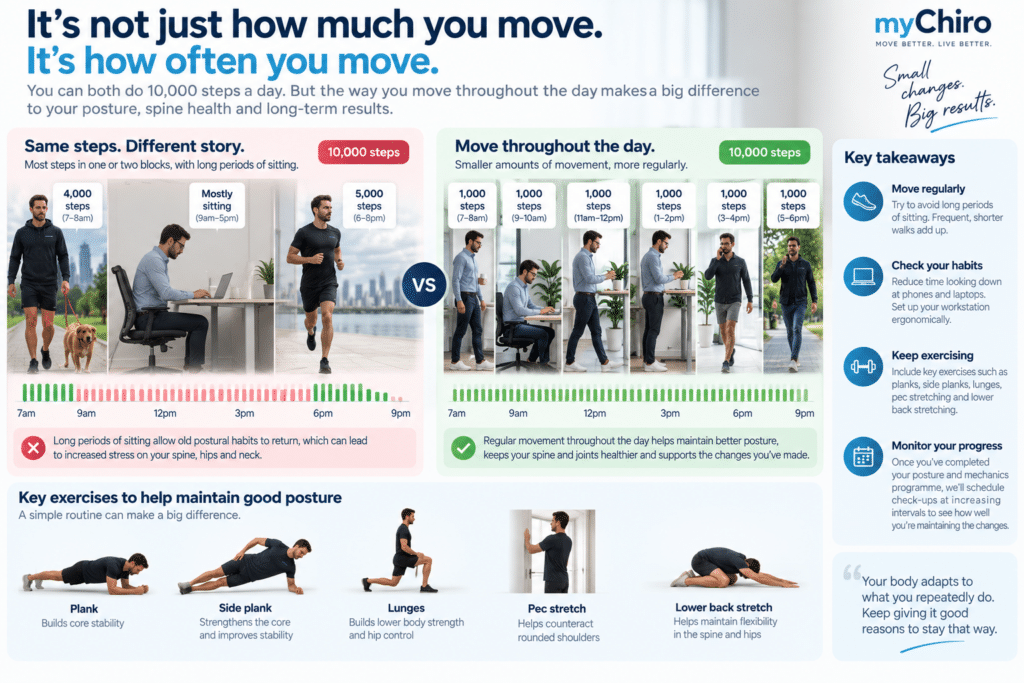
I am not suggesting you need exactly 1,000 steps every hour. The principle is what matters: do not let hours go by without moving.
Stand up. Walk to get some water. Take a phone call on your feet and walk while you talk. Use the stairs. Walk around the office. Get outside at lunchtime.
Even fairly small amounts of movement scattered through the working day break up long stretches of sitting.
Working from home makes this surprisingly hard
We notice this most with people who work from home.
When you commute to an office, movement happens almost by accident. You walk to the station, change trains, walk from the station to work, go to meetings, walk out for lunch and move around the building.
At home, the commute might be bedroom, kitchen, desk.
It is entirely possible to own an excellent ergonomic chair, an expensive standing desk and a perfectly positioned monitor, and still barely move for eight hours.
That is why I do not think ergonomics alone is the answer. The best sitting position is still one you need to get out of regularly.
Finished a course of treatment and want a plan for keeping the changes? Book a review at our Canary Wharf clinic.
What happens after the third layer?
Once someone has reached the goals we set for the third layer, we do not want to keep seeing them at the same frequency. Instead, we start spacing the check-ups further apart.
We might see them again after a few weeks and reassess the measurements and mechanical findings we originally identified.
If the changes are holding, the gap gets longer. Then we reassess again.
Over time we are answering one useful question: how well does your body hold these changes on its own? Everyone is different.
Someone who exercises regularly, moves through the day and has changed the habits that contributed to the original problem may hold their improvements very well.
Someone who spends ten hours a day largely sedentary may find the old patterns creep back sooner.
The aim is to find the point where you keep the improvements with the least intervention necessary.
Think of it like fitness
The easiest comparison is physical fitness.
Imagine spending six months getting stronger and fitter, and then stopping exercise completely.
Would you expect exactly the same strength and fitness two years later? Probably not.
That does not mean the six months of training failed. It means your body adapted to the training, and then adapted again when the training stopped.
Posture and movement work in a similar way: they follow what you keep doing.
Where the three layers leave you
After working through the three layers, the focus turns to maintaining the mobility, strength and regular movement you have built.
So after the work of changing how you move, you do not need to obsess over perfect posture. You need to keep giving your body good reasons to hold on to the changes.
Keep exercising.
Look after the habits that matter.
And most of all, keep moving.
FAQ
How often will I need check-ups once I’ve finished treatment?
There is no fixed schedule. After the third layer we space reviews progressively further apart and reassess the original measurements each time. If the changes are holding well, the gap keeps growing.
Is 10,000 steps a day enough to keep my posture?
A daily step total does not tell you how long you spent sitting. Ten thousand steps taken in two blocks either side of an eight-hour sitting stretch still leaves most of the working day without movement. Spreading at least some of that movement through the day is the change we ask for most.
Do I need a standing desk?
Not necessarily. A standing desk is useful if it helps you change position more often, but standing still for hours is still staying still. The habit of moving regularly matters more than the furniture.
Will my posture go back to how it was if I stop the exercises?
It may drift, gradually, particularly if the habits that contributed to it return as well. That is not a sign the earlier work failed. It is the same adaptability that made the improvement possible, working in the other direction.
How do I remember to move when I work from home?
Tie movement to things that already happen. Stand for every phone call, fetch water from the kitchen rather than keeping a bottle at the desk, walk before you start and after you finish as a replacement for the commute, and set a reminder if hours tend to disappear.
Want to know how well your body is holding on to the changes you have made? Book a review at MyChiro Clinic in Canary Wharf.
This article is general information about keeping improvements in posture and movement. It is not individual clinical advice and it is not a substitute for an assessment. If you have new, severe or worsening pain, numbness, pins and needles or weakness in the arms or legs, or pain that wakes you at night, please speak to your GP.